Ulpan.com's daily dose of Hebrew Headline Animator

Showing posts with label rabbi riddle. Show all posts

3/13/12

Rabbi Riddle says...

This week's Torah Portion, Vayakhel, describes the materials used for the Mishkan in the desert. The Torah repeats the entire description to teach us the importance of each item, from the Holy Ark to the pegs that held down the curtains. Similarly, G-d made every person different, giving each a unique mission to fulfill!
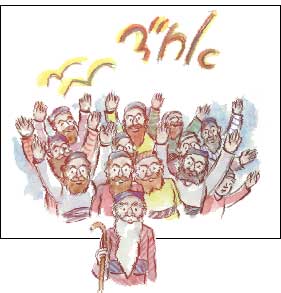
    Every Jewish soul was at Mount Sinai to receive the Torah. Our sages say that if one Jew had been missing, the entire nation would have been incomplete, and we could not have received the Torah!
    The value of the Hebrew word for One, Echad, equals 13. Our forefather Jacob and his twelve sons also equal 13. This teaches us that the entire Jewish nation is truly one! The Midrash states that the Jewish people are compared to a palm tree which has no waste. We eat the dates, use the branches for the Lulav on the holiday of Sukkos, the thin leaves to cover the Sukkah, its fibers for rope, its prickly leaves for brooms, and its trunk for roofing. So, too, the Jewish nation contains all types of people, from Torah scholars to simple people who perform good deeds and give charity.
    2/27/12

    Rabbi riddle says...wipe out!

    http://www.rabbiriddle.org/
    Parshas Tetzaveh is the only portion in Shemos where Moshe's name is missing. On many occasions, the Jewish people rebelled against G-d. When G-d threatened to destroy the Jewish people and make Moshe the father of a new nation, Moshe said, "If you will not forgive the Jewish people, please wipe me out of your book!"
    Although G-d forgave the Jewish people, He still took Moshe's name out of this Parsha. This shows us Moshe's self-sacrifice and Ahavas Yisroel (love of a fellow Jew). It also teaches us that the words of the righteous should not be taken lightly.

    2/16/12

    rabbi riddle says....It only takes a little to help a lot!

    www.rabbiriddle.org


    Most people give tzedaka in the form of money:
    Tzedaka also includes learning with someone who knows less than you! Farmers can give tzedaka in many ways. When they harvest crops from the field, they leave a corner for the poor; they also leave the single ears of corn that fall to the ground for the poor; and when they forget part of their crop they must leave it for the poor.

    www.rabbiriddle.org